Industrial Safety Engineering Department
M.E. Industrial Safety Engineering

Department of Industrial Safety Engineering

Department of Industrial Safety Engineering offers a specialized 2-year postgraduate program focusing on workplace safety, health engineering, risk management, and compliance with industrial safety standards to prevent accidents and promote worker well-being.

Advanced safety management and risk assessment
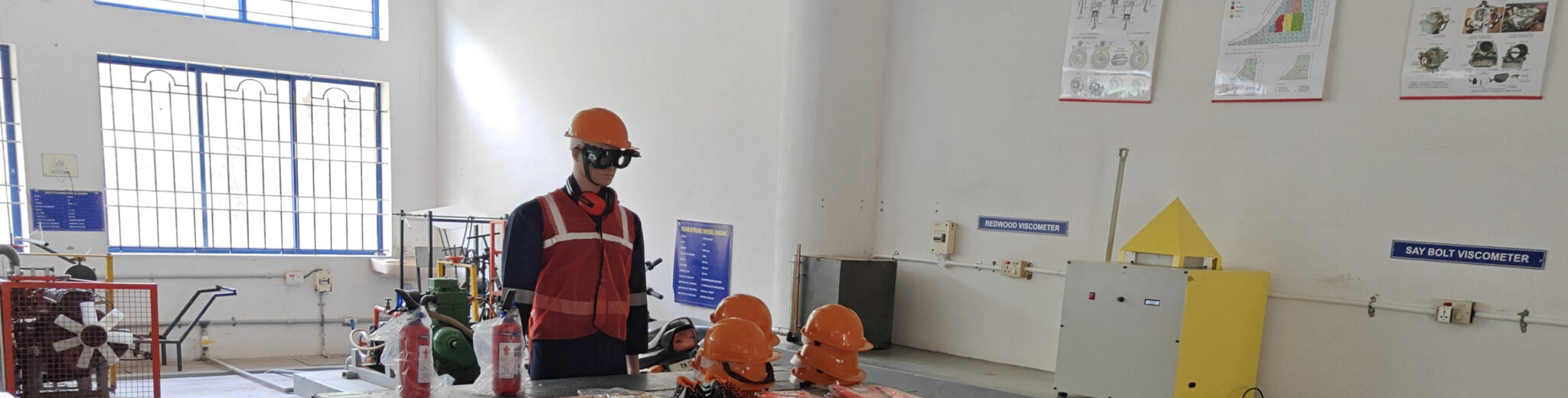
State-of-the-art safety testing laboratories
Industry partnerships and internships
Focus on regulatory compliance and safety standards

About the Department

The Department of Industrial Safety Engineering is dedicated to creating professionals who can ensure workplace safety, implement health engineering solutions, and manage risk effectively across various industries. Our 2-year postgraduate program focuses on practical applications of safety principles, regulatory compliance, and advanced safety management systems to prevent accidents and promote worker well-being. The department has well-established laboratories with safety testing equipment, risk assessment tools, and simulation software to provide practical exposure to students. The rapidly evolving industrial safety landscape poses challenges to students to stay updated with the latest developments in safety regulations, risk management technologies, and occupational health standards. Our qualified faculty and well-equipped labs ensure that our students are well prepared to take on these challenges. All graduates of Industrial Safety Engineering find excellent placements in manufacturing industries, construction companies, oil & gas sectors, and consulting firms.

Vision

To be a leading department in industrial safety education and research, producing professionals who can create and maintain safe, healthy, and compliant workplace environments across all industries through engineering excellence and safety innovation.

Mission
  • Provide comprehensive education in industrial safety and health engineering with state-of-the-art laboratories, testing facilities, and modern teaching-learning systems.
  • Produce skilled safety engineers and professionals with technical expertise, leadership qualities, communication skills, social responsibilities, and ethical values.
  • Inculcate professional skills to function as proficient safety engineers capable of designing, implementing, and managing comprehensive safety systems and solutions.
  • Promote research and development activities in safety technologies, risk management, occupational health, and regulatory compliance.

Basic Skills

PEO 1: To apply fundamental knowledge of industrial safety, engineering principles, and risk management to analyze, design, and develop comprehensive workplace safety solutions.

Technical Skills

PEO 2: To enable graduates to pursue higher education and research, or have a successful career in manufacturing industries, construction companies, oil & gas sectors, or as safety consultants.

Managerial Skills

PEO 3: To ensure that graduates will have the ability and attitude to adapt to emerging technological changes in safety regulations, risk assessment methodologies, and occupational health standards.

Engineering knowledge

PO 1: Apply the knowledge of mathematics, science, engineering fundamentals, and an engineering specialization to the solution of complex engineering problems.

Problem analysis

PO 2: Identify, formulate, review research literature, and analyze complex engineering problems reaching substantiated conclusions using first principles of mathematics, natural sciences, and engineering sciences.

Design/development of solutions

PO 3: Design solutions for complex engineering problems and design system components or processes that meet specified needs with consideration for public health, safety, and cultural, societal, and environmental factors.

Conduct investigations of complex problems

PO 4: Use research-based knowledge and methods including experiments, analysis, interpretation of data, and synthesis of information to provide valid conclusions.

Modern tool usage

PO 5: Create, select, and apply appropriate techniques, resources, and modern engineering and IT tools including prediction and modeling to complex engineering activities with an understanding of the limitations.

The engineer and society

PO 6: Apply reasoning informed by contextual knowledge to assess societal, health, safety, legal, and cultural issues relevant to professional engineering practice.

Environment and sustainability

PO 7: Understand the impact of professional engineering solutions in societal and environmental contexts, and demonstrate knowledge of sustainable development.

Ethics

PO 8: Apply ethical principles and commit to professional ethics and responsibilities and norms of engineering practice.

Individual and team work

PO 9: Function effectively as an individual, and as a member or leader in diverse teams, and in multidisciplinary settings.

Communication

PO 10: Communicate effectively on complex engineering activities with the engineering community and society, such as writing reports, designing documentation, making presentations, and giving and receiving clear instructions.

Project management and finance

PO 11: Demonstrate knowledge and understanding of engineering and management principles and apply them to one's own work, as a team member or leader, to manage projects in multidisciplinary environments.

Life-long learning

PO 12: Recognize the need for and have the preparation and ability to engage in independent and life-long learning in the broad context of technological change.
Occupational Safety & Health Management

PSO 1: Excel in analyzing, designing, and implementing occupational safety and health management systems by applying foundational concepts of industrial safety, risk assessment, and health engineering.

Risk Assessment & Safety Compliance

PSO 2: Apply principles of risk assessment, hazard analysis, regulatory compliance, and safety standards to develop and maintain safe workplace environments across various industries.

Emerging Safety Technologies

PSO 3: Exhibit emerging safety technologies such as advanced fire safety systems, IoT-based safety monitoring, ergonomic solutions, and smart safety management to innovate ideas and solutions to existing or novel industrial safety challenges.

2 Years

Program Duration

30

Annual Intake

95%+

Placement Rate

AICTE

Approved

Academic Curriculum

Our postgraduate program in Industrial Safety Engineering provides comprehensive education in occupational safety, health engineering, risk assessment, and safety management systems with emphasis on regulatory compliance and practical applications.

YEAR 1 – Semester 1
Core Subjects
  • Occupational Safety and Health
  • Risk Assessment and Management
  • Industrial Safety Engineering
  • Safety regulations and Compliance
  • Industrial Hygiene and Toxicology
  • Ergonomics and Human Factors
Laboratory
  • Safety Testing and Measurement Lab
  • Risk Assessment Simulation Lab
Electives (Choose 1–2)
  • Environmental Safety Management
  • Process Safety Management
  • Chemical Safety Engineering
  • Construction Safety Management
YEAR 1 – Semester 2
Core Subjects
  • Fire Safety Engineering
  • Disaster Management and Emergency Response
  • Safety Statistics and Data Analysis
  • Safety Training and Development
  • Safety Management Information Systems
Mandatory
  • Safety Audit Project
  • Industrial Training (4–6 weeks)
Laboratory
  • Fire Safety Testing Lab
  • Emergency Response Drill Lab
Electives (Choose 1–2)
  • Aviation Safety Management
  • Marine Safety Engineering
  • Safety Instrumentation and Control
  • Electrical Safety Engineering
YEAR 2 – Semester 3
Core Subjects
  • Advanced Safety Engineering
  • Safety Research Methodology
  • Human Resource Management in Safety
Electives (Choose 1–2)
  • Healthcare Safety Management
  • Transportation Safety Engineering
  • Oil and Gas Safety Management
  • Cybersecurity for Industrial Systems
Major Project Phase – I

Problem identification, literature review, safety audit methodology

YEAR 2 – Semester 4
Major Project Phase – II
  • Safety Research Dissertation
  • Industry-based Safety Implementation Project
  • Thesis Defense and Viva voce

Our Faculty Team

Our department has highly qualified and experienced faculty members specializing in industrial safety, occupational health, risk management, and safety engineering with strong industry connections.

Dr.P.THANGAVEL

Professor

Qualification: ME., PhD

P.ELANGOVAN

Assistant Professor

Qualification: BE., ME.

Faculty Achievements
  • Best Safety Faculty Awards from national safety councils
  • Research grants from Ministry of Labour & Employment
  • Active membership in National Safety Council
  • Industry consultancy projects in safety management
Faculty Qualifications & Expertise
Academic Qualifications:
  • Ph.D. holders in Industrial Safety and Health Engineering
  • M.E/M.Tech in Safety Engineering disciplines
  • Professional certifications in OSHA and NEBOSH
  • Industry and research experience in safety management
Areas of Expertise:
  • Occupational Safety & Health Management
  • Fire Safety & Emergency Response Planning
  • Industrial Hygiene & Environmental Safety
  • Risk Assessment & Safety Auditing

Department Facilities

Occupational Safety Laboratory
  • Advanced lab equipped with personal protective equipment
  • Safety testing instruments and monitoring devices
  • Workplace safety assessment training equipment
  • Occupational health monitoring systems
Fire Safety Laboratory

Specialized facility with fire extinguishers, fire detection systems, smoke detectors, and fire simulation equipment for hands-on fire safety training and emergency response drills.

Industrial Hygiene Laboratory

Well-equipped lab with air quality monitoring equipment, noise level meters, radiation detectors, and chemical analysis instruments for industrial hygiene assessment.

Safety Training Center

Dedicated training facility with simulation equipment, safety demonstration models, and multimedia resources for conducting safety training programs and emergency response drills.

Safety Software and Tools
Risk Assessment Software:
  • Risk Assessment Software
  • Safety Management Systems
  • OSHA Compliance Tools
  • Emergency Response Planning Software
Safety Analysis Tools:
  • Industrial Hygiene Monitoring Systems
  • Fire Safety Simulation Software
  • Safety Audit Tools
  • Incident Investigation Software

Research & Innovation

Our department is actively engaged in cutting-edge research activities focused on advanced safety technologies, risk management innovations, and occupational health engineering solutions.

Workplace Safety Innovation

Research on advanced personal protective equipment, safety monitoring systems, and innovative workplace safety technologies.

Occupational Health Engineering

Studies on workplace health monitoring, exposure assessment, and development of healthier working environments.

Advanced Risk Assessment

Development of predictive risk models, AI-based safety analysis, and advanced hazard identification methodologies.

Fire Safety Innovation

Research on advanced fire detection systems, smart fire suppression technologies, and emergency response optimization.

Current Research Projects
Academic Projects:
  • Smart Safety Monitoring System for Industrial Environments
  • Predictive Risk Analysis Using Machine Learning
  • Fire Detection and Suppression System Optimization
  • Industrial Hygiene Assessment Methodologies
Industry Projects:
  • Safety Audit Automation for Manufacturing Plants
  • Emergency Response Planning Software Development
  • Worker Health Monitoring Systems
  • Chemical Hazard Assessment Tools
Recent Publications
  • "Advanced Risk Assessment in Industrial Safety" - Journal of Safety Engineering
  • "Fire Safety Systems in Modern Industries" - International Fire Safety Journal
  • "Occupational Health Monitoring Technologies" - Industrial Health Journal
  • "Smart Safety Systems for Industry 4.0" - Safety Science Journal

Placement Statistics

Our Industrial Safety Engineering graduates are successfully placed in leading manufacturing companies, oil & gas industries, construction firms, and safety consulting organizations with excellent career opportunities.

2024 Placement Overview
  • Highest Package: ₹12 LPA
  • Average Package: ₹6.5 LPA
  • Placement Percentage: 95%
  • No. of Companies Visited: 45+
  • Manufacturing Sector: 40%
  • Total Students Placed: 28+
  • Core Safety Companies: 60%
  • Consulting Firms: 25%
Top Recruiting Companies
Manufacturing Industries:
  • Tata Steel
  • Reliance Industries
  • L&T Construction
  • BHEL
  • IOCL
  • SAIL
Safety Consulting:
  • Vedanta Resources
  • Adani Group
  • Jindal Steel
  • Safety Consultants India
  • DNV GL
  • Bureau Veritas
Career Opportunities
Safety Management Roles:
  • Safety Manager
  • Safety Officer
  • Risk Assessment Specialist
  • Fire Safety Officer
  • Industrial Hygienist
Specialized Roles:
  • Health and Safety Consultant
  • Safety Auditor
  • Safety Trainer
  • HSE Manager
  • Safety Analyst
Placement Preparation
Certification Preparation:
  • Safety certification preparation (OSHA, NEBOSH)
  • Safety audit training and workshops
  • industrial visits to manufacturing plants
  • Mock interviews with safety professionals
Career Development:
  • Resume building for safety positions
  • Soft skills for safety management roles
  • Professional safety certification guidance
  • Career counseling in safety engineering

Department activities

Engaging student activities, technical events, and industry interactions that provide practical experience and professional development opportunities in industrial safety.

Student Clubs and Societies
  • Safety Club: Technical discussions, safety workshops, and field visits to industrial facilities.
  • Fire Safety Club: Fire safety awareness programs and emergency response training.
  • Industrial Hygiene Club: Workplace health monitoring and environmental safety activities.
  • Risk Management Club: Risk assessment projects and safety audit exercises.
Technical Events
  • SAFEX: Annual industrial safety symposium and technical exhibition
  • Safety Audit Competition: Industrial facility safety assessment contest
  • Emergency Response Challenge: Mock emergency scenario competition
  • Fire Safety Workshop: Advanced fire fighting and prevention training
  • Risk Management Contest: Risk identification and mitigation competition
  • Safety Quiz: Technical quiz on industrial safety regulations
Industry Interactions
  • Guest lectures by safety engineering industry experts
  • industrial visits to manufacturing plants and safety facilities
  • Internship programs with leading industrial companies
  • Industry-sponsored safety research projects
  • Alumni mentorship programs with safety professionals
  • Technical seminars on latest safety standards and regulations
Workshops and Training
  • OSHA and international safety standards training
  • Safety audit and inspection techniques
  • Emergency response planning and execution
  • Industrial hygiene monitoring and assessment
  • Safety management systems implementation
  • Professional safety certification preparation

Ready to Join Industrial Safety Engineering?

Build a safer future for industries and workers. Contact our department for more information about the program and admission process.